
Specific Loan programs guidelines etc.

Loan Programs

Lock Your Rate in March, Get Your Appraisal Free—Here’s the Deal

Here’s something I don’t say often: this month, you can save real money right out of the gate.

If you lock your rate with us anytime in March 2026, we’ll reimburse your appraisal cost at closing—up to $600. That applies to Conventional, FHA, and VA loans.

No catch. No fine print buried three pages deep. Just a straightforward credit back to you when you close.

Why This Matters

Let me break this down. The appraisal is one of those upfront costs that catches people off guard. You’re already juggling down payment funds, inspection fees, and maybe some repairs. Then boom—another $500 to $650 for the appraisal.

It’s not optional. The lender needs it. But this month? We’re covering it.

Bottom line: That’s $600 you can put toward something else—moving costs, furniture, or just keeping it in your pocket. After 25 years in this business, I know every dollar counts when you’re buying or refinancing a home.

Who Qualifies?

Here’s what you need to know:

  • Lock your rate in March 2026 (that means between now and March 31st)
  • Most Conventional, FHA, and VA loans qualify
  • You get the reimbursement at closing—we credit it back when the deal closes
  • Up to $600 depending on your actual appraisal cost

Real talk: You need to actually close the loan to get the credit. If you lock and then decide not to move forward, the offer doesn’t apply. Fair enough, right?

Perfect Timing for Veterans

If you’re using your VA loan benefit, this is especially valuable. VA loans already come with zero down payment and competitive rates. Now add a free appraisal? That’s a serious advantage.

I’ve worked with hundreds of veterans over the years, and one thing I hear constantly is appreciation for straightforward benefits. No games. This is exactly that.

Whether you’re a first-time buyer using your benefit or a veteran who’s used it before (yes, you can use it again), this March offer stacks on top of everything the VA loan already gives you.

What You Need to Do

The mission is simple:

1. Connect with us before March 31st. Get pre-approved if you’re buying, or let’s talk through your refi scenario if you’re looking to lower your rate or pull cash out.

2. Lock your rate in March. Once we’ve got your full application and you’re ready, we lock it in. That’s when the appraisal reimbursement gets attached to your loan.

3. Close your loan. We process everything, you get to closing, and that appraisal cost comes back to you as a credit.

That’s it. Three steps.

Why We’re Doing This

Here’s what most people don’t realize: March can be a smart time to lock a rate. We’re past the holiday chaos, spring buying season is just starting to heat up, and inventory is beginning to move.

We want to help you take advantage of this window. And frankly, we want to earn your business by making the process as financially painless as possible.

I’ve been doing this for over 25 years. I’ve seen every gimmick and every legitimate offer. This is the latter—a real benefit that puts money back in your pocket.

Ready to Move Forward?

If you’ve been thinking about buying or refinancing, now’s the time to get the intel you need. Let’s talk through your situation, run the numbers, and get you locked in this month.

You can reach out directly, and we’ll get you pre-approved and on track. Whether you’re in DC, Virginia, Maryland, or beyond—if you’re ready to move, let’s make March count.

Roger that?

Let’s get to work.


Robert Musseman | NMLS# 85152
Oak Street Mortgage | NMLS# 1618618
www.nmlsconsumeraccess.com

First-Time Homebuyer Loans: Great Deals Hiding in Plain Sight

Here’s what most people don’t realize: you don’t need a massive down payment to buy a home. And in many cases, you don’t even need to be a first-time buyer to access some of the best loan programs available.

After 25+ years in this business, I’ve seen too many qualified buyers sit on the sidelines because they think they need 20% down. That’s just not the case anymore.

Let me break this down.

What Makes First-Time Homebuyer Programs Such a Good Deal?

These programs were designed to help people get into homes, and they do exactly that. Here’s what you’re looking at:

  • Down payments as low as 3% – Yes, you read that right.
  • Competitive interest rates – Often better than conventional loans
  • Grant programs available – In some cases, you can stack grants to reduce your cash needed even further

Bottom line: these programs can be game-changers for qualified buyers in the DC/VA/MD market.

The Income Question Everyone Asks

Here’s the deal: many of these programs have income limits. They’re designed to help folks who need the assistance, so there are caps based on your area’s median income.

In the DC metro area, we’re talking median incomes typically in the $120-150k range. Because this is a high-cost area, those limits are higher than you might expect. If you’re in that range or lower, you may very well qualify.

Real talk: Don’t assume you make too much until you actually check. I’ve had clients surprised to learn they qualified when they thought they wouldn’t.

You Don’t Actually Have to Be a “First-Timer”

This surprises people.

Many programs will qualify you if you simply haven’t owned a home in the last three years. Some programs don’t even require that. The key factors are usually:

  • Meeting the income requirements
  • The property being your primary residence
  • Completing any required homebuyer education (more on that in a second)

So if you owned a place years ago, went through a divorce, relocated for work, or just got back on your feet financially – you might still be eligible.

The Homebuyer Counseling Requirement

Some programs require you to complete homebuyer education or counseling. Before you groan, here’s what that actually looks like:

Most of our customers complete this online, at their own pace. It’s not sitting in a classroom for hours. You’ll learn about the homebuying process, budgeting, and maintaining your home. Honestly, even experienced buyers pick up useful intel.

It’s painless, and it’s required for good reason – we want you to succeed as a homeowner.

The Mortgage Insurance Reality

Let’s address this head-on: if you put down less than 20%, you’ll have mortgage insurance (MI). That’s an additional monthly cost that protects the lender.

Is it ideal? No. But here’s the math that matters: waiting another 2-3 years to save up 20% while paying rent and watching home prices climb often costs you more than the MI would.

Plus, with some loan types, you can remove MI once you hit 20% equity through a combination of paying down the loan and home appreciation.

The Strategy Most People Miss

Here’s something interesting: even if you CAN afford to put 20% down, you might want to explore these programs anyway.

Why? Because if you qualify based on income, you can still use the program, benefit from excellent rates, and avoid mortgage insurance by putting 20% down. You get the best of both worlds.

I’ve had clients with significant savings who qualified for these programs and got better terms than they would have with a conventional loan. It’s worth exploring.

Your Mission: Get the Facts

Every first-time homebuyer program has different rules and requirements. Some are state-specific, some are county-specific, and some are lender-specific.

The key is talking to someone who knows the local market and these programs inside and out. Someone who can run the numbers based on your specific situation and tell you what you actually qualify for.

Here in the DC metro area, we have access to several excellent programs. The strategy is matching the right program to your situation – your income, your savings, your timeline, and your goals.

What You Should Do Next

Don’t make assumptions about what you can or can’t afford. Don’t assume you make too much to qualify. And definitely don’t think you need to wait until you have 20% saved.

Get pre-qualified. Understand your options. Look at the real numbers.

In 25+ years, I’ve helped hundreds of first-time buyers (and second-time buyers using first-time programs) get into homes they thought were out of reach. The programs are there. The question is whether you’re going to use them.

If you’re in the DC, Virginia, or Maryland area and want to explore your options, let’s talk. No pressure, no sales pitch – just straight answers about what programs you might qualify for and what makes sense for your situation.

Roger that?

Robert Musseman, Senior Loan Officer
Oak Street Mortgage
NMLS ID# 85152 | Company NMLS ID# 1618618
www.nmlsconsumeraccess.com

What are “Alternative” or “Non-QM” Mortgages?

Can’t qualify for a traditional mortgage? You have options.

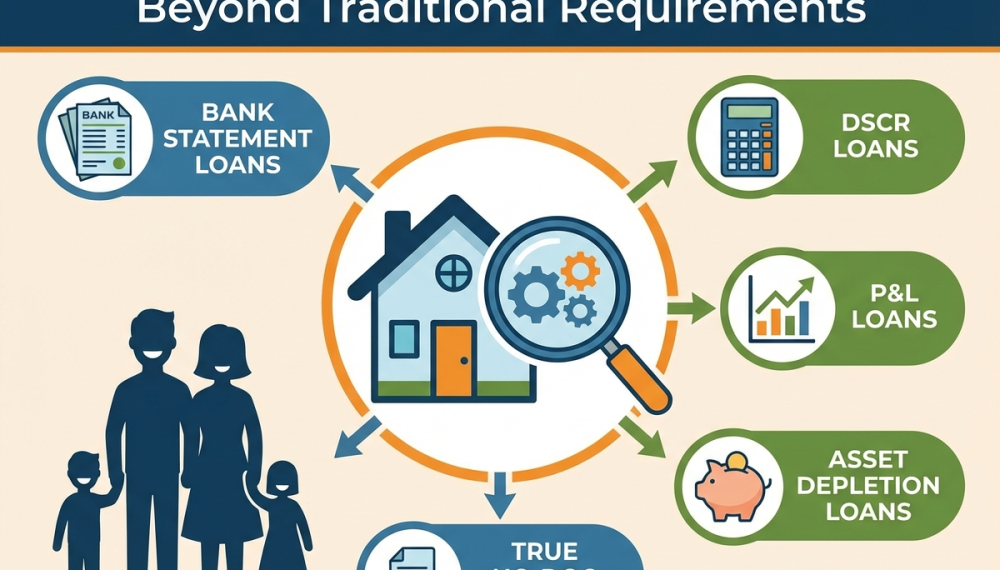
You may have heard different terms for these specialized loan programs: “Bank Statement Loans,” “DSCR,” “Asset Depletion,” “P&L Loans,” or “No Doc” loans. These are all types of mortgages that fall into the Alternative or Non-QM (Non-Qualified Mortgage) category, and they can be game-changers for borrowers who don’t fit the traditional lending box.

Traditional Mortgages: The Standard Path

Traditional mortgage loans—including VA, FHA, USDA, and conventional conforming and jumbo loans—follow strict federal guidelines on income documentation, property types, credit scores, and debt-to-income ratios. When you qualify, government backing or GSE guarantees reduce lender risk, resulting in lower interest rates and down payment requirements as low as 0-3%.

But not everyone fits these guidelines. Self-employed with business deductions? Unique property? Credit issues? Real estate investor with multiple properties? Alternative loans offer the flexibility traditional loans cannot.

Trade-off: Alternative loans typically require larger down payments—10-15% for primary residences, 20-25% for investment properties.

Alternative Loan Types Explained

Bank Statement Loans

Best for self-employed borrowers with strong cash flow but lite tax-reported income. We use your consistent monthly bank deposits over 12-24 months to calculate qualifying income instead of tax returns.

Profit & Loss (P&L) Loans

We can use a Profit and Loss statement prepared by you or your bookkeeper as the income basis. A CPA or tax professional must review and sign off on the P&L.

DSCR Loans (Debt Service Coverage Ratio)

For rental properties only. We don’t evaluate your personal income at all—just whether the property’s rental income exceeds the mortgage payment. If the property supports itself, you qualify. Ideal for investors with complex income situations. Requires 20-25% down payment.

Asset Depletion Loans

No job or traditional income? If you have substantial savings, stocks, bonds, or retirement accounts, we convert those assets into calculated monthly income that qualifies you for a mortgage.

True “No-Doc” Loans

We work with select exempt institutions offering true no-documentation loans for specific situations. These work well for properties with substantial equity where you can articulate a logical repayment strategy.

Other Non-QM Options

Additional programs address credit flexibility, foreign nationals, special property types (unique condos, rural properties, mixed-use), and complex income scenarios.

Finding Your Solution

Every borrower’s situation is unique. Whether you’re a business owner, real estate investor, retiree, or rebuilding after a financial setback, there’s likely a mortgage solution for you.

Ready to explore which alternative loan program fits your needs? Contact me for a free consultation. I’ll analyze your specific situation and find the best option to help you achieve your real estate goals.

15-Year Mortgages: The Tremendous Value Most Homebuyers Overlook

I sat across from a young couple last week who’d been pre-approved by their bank for a 30-year mortgage at 6%. They were proud—and honestly, getting approved is an accomplishment. But when I asked if they’d considered a 15-year loan, they looked at me like I’d suggested buying the house with cash.

“We surely could not afford a 15-year payment,” they said.

Here’s the deal: Too many people don’t even evaluate the 15 year option, and it’s costing them hundreds of thousands of dollars.

Can you afford the payment and save big?
First make sure you have a handle on the math.

Let me break this down with real numbers. This table below shows the payment comparisons for 15 and 30 year fixed rate loans from $100,000 to $1,000,000.  The payment factor is 1.35.  Simply multiply any 30 year P&I payment by 1.35 to get the approximate 15 Year P&I Payment:

We are currently offering 15 Year fixed at about 5.00% APR and 30 Year fixed at about 5.80% APR to our best qualified borrowers. (Rates change daily and depend on your specific credit profile. Not a commitment to lend.)

Loan Amount 30 Year Fxd Pmt Factor 15 Year Fxd Pmt
$100,000 $586.75 1.35 $792.12
$200,000 $1,173.51 1.35 $1,584.23
$300,000 $1,760.26 1.35 $2,376.35
$400,000 $2,347.01 1.35 $3,168.47
$500,000 $2,933.77 1.35 $3,960.58
$600,000 $3,520.52 1.35 $4,752.70
$700,000 $4,107.27 1.35 $5,544.82
$800,000 $4,694.02 1.35 $6,336.93
$900,000 $5,280.78 1.35 $7,129.05
$1,000,000 $5,867.53 1.35 $7,921.17

For a $400,000 loan for example, the monthly payment is about $821/month higher with a 15 year loan. But you save over $275,000 in interest over the life of the loan. Check out your savings at different points in the table below:

$400,000 Loan — 30 Yr Fixed @ 5.8% vs 15 Yr Fixed @ 5.0%
End of Year Interest Saved
5 $24,087
7 $38,847
10 $67,379
15 $134,815
20 $207,240
30 $275,553

Read that again. Two hundred and seventy-five thousand dollars.

Here’s What Most People Don’t Realize

After 25 years in this business, I’ve watched clients choose the “safer” 30-year option over and over. I get it—the lower payment feels more comfortable. But here’s the real talk: that comfort comes with an enormous price tag.

The 15-year mortgage gives you:

  • A lower interest rate. Usually 0.5% to 0.90% less than the 30-year. Lenders reward you for taking less risk.
  • Forced equity building. You’re paying down principal aggressively from day one, not just feeding the interest machine.
  • Freedom in half the time. Imagine being mortgage-free at 50 instead of 65. That’s a completely different retirement picture.
  • Less total risk. You owe less, faster. If life throws you a curveball, you’ve got more equity to work with.

The Payment Reality Check

Bottom line: Yes, $821 more per month is real money. But let’s look at what you’re actually getting.

That extra $821 isn’t disappearing—it’s building your equity at warp speed. On a 30-year loan, your first payment sends maybe $1,328 to principal. On the 15-year? You’re putting $1,822 toward principal right out of the gate.

When It Makes Perfect Sense

The 15-year mortgage is a tremendous value if you:

  • Have stable income you can count on
  • Want to build wealth through equity, not just hope for appreciation
  • Are in your peak earning years (40s-50s typically)
  • Plan to stay in the home long-term
  • Value being debt-free over keeping monthly payments low

When the 30-Year Makes More Sense

Look, I’m not here to sell you something that doesn’t fit. There are absolutely times when the 30-year is the right call:

  • You’re stretching to buy in a competitive market and need the lower payment
  • You’re early in your career with income expected to grow substantially
  • You’ve got other high-interest debt to tackle first
  • You’re investing heavily in retirement accounts and maxing out tax-advantaged options
  • The payment difference genuinely strains your monthly budget

But here’s my challenge: Don’t just assume you can’t afford the 15-year. Run the actual numbers. Look at your budget honestly. You might surprise yourself.

If you want to run the numbers on your specific situation—whether you’re buying, refinancing, or just exploring options—let’s talk. No sales pitch, just straight intel on what makes sense for your circumstances.

Call or email me anytime for additional numbers or details.

Robert Musseman
703-309-2537
robm@oakstreet.coregrowthexperts.com
Senior Loan Officer, Oak Street Mortgage
NMLS ID# 85152 | Company NMLS ID# 1618618
Visit www.nmlsconsumeraccess.com for licensing information

Show me the money! Today’s cashout refinance loan options

Values have gone up very quickly recently, so it may benefit you to refinance your real estate at very low rates in the 3’s, with very low payments, to payoff debts, invest the proceeds, improve your home, or for other needs.


I hope you will find these notes useful. Of course, please call/email anytime with questions.

 
CASHOUT LOANS SECURED BY YOUR RESIDENCE:
Mortgage loans secured by your residence offer the most cash relative to your home’s value and the lowest rates. We can finance up to 80% of your home’s value with traditional low rate 30 year fixed rate loans. However, the lowest rates are available for cashout loans of up to 75% of your home’s value.
 
We also offer options as high as 85% of your home’s value with an FHA loan, and you can even cashout up to 90% of your home’s value with a VA loan if you are a Veteran. (The VA also offers 100% cashout loans but the red tape and restrictions are normally a bit too onerous.). 90% is pretty darn good for cashout.
 

The VA and FHA options are a bit more costly than traditional but they allow for those higher LTVs which may be worth the extra cost depending on your situation. Let’s face it, all rates are pretty low right now if you have a good use for the funds.

 
CASHOUT LOANS SECURED BY YOUR RENTAL HOUSES:
You can generally receive up to 75% of the property’s value, and that’s at a low rate fixed for 30 years in the high 3’s for our traditional offerings. We offer slightly higher rates and LTV options for special situations. Not too bad.
 
 
SOME FINE PRINT
  • You must have solid credit/income/employment history etc for the fully documented long term fixed rate loan options backed by the Government. You must qualify and be approved but they are not overly restrictive.
  • We do have other cashout loan options available if you do not quite “fit the box” of the traditional government guaranteed/insured loans.
  • For my investor clients: If you have owned the property less than 6 months, we need to discuss some restrictions and some options to resolve.
  • If you own commercial real estate or buildings/warehouses/offices, we can discuss those as well.

    I look forward to your questions and thoughts. Just drop me an email or give me a call anytime.

New Agency ARM Loan Specifics: Looking Under the Hood

In our last blog we covered the basics of the new Adjustable Rate Mortgage(ARM) loans being offered and for whom they might be a good option.  In this blog we will cover some specific details on how these types of loans work.

An ARM loan is a 30 year amortizing loan, just like a regular 30 year mortgage.  The difference is that after an initial fixed rate and payment period, the rate and payment will change periodically based on pre-defined rules and limits.

The initial rate and payment for the fixed period (usually the first 5, 7, or 10 years) is straightforward.  Understanding how your rate and payment will change after the fixed period is the key to understanding your ARM Loan.  Every industry has its own jargon.  Ours is no different.  When you are looking at ARM Loans you will see them named a certain way.  Examples:

  • 10/6 ARM
  • 7/6 ARM
  • 5/6 ARM

These loans all amortize over 30 years.  So for a 7/6 ARM for example the initial low rate and payment you are offered will be fixed for the first 7 YEARS of the loan.  The first adjustment to rate and payment will occur at 7 years. The rate and payment will change subsequently every 6 months thereafter, hence 7/6.

There are some key terms related to ARMs you will need to know:

Index:  This is an interest rate that changes daily and is published for everyone to see online and in major publications like the Wall Street Journal.

Margin:  This is a rate that is fixed forever by your lender at the time you initially get your loan.  Your loan officer can let you know what the Margin will be on your ARM Loan.

Fully Indexed Rate:  This rate is simply the index rate plus the margin rate and is calculated everytime your loan rate is due to be adjusted.

Every time the loan rate and payment are due to adjust, the lender will check the index rate online 30 days before your first adjusted payment is due and adjust your rate by adding the current index rate value to your margin rate value.  This will be your new Fully Indexed Rate and will used to calculate your new payment.

Example:  On a 5/6 ARM at the end of 5 years, your loan is due for its first adjustment.  The lender looks online and sees the index value is 1.55%.  The margin on your loan is 2.75%.  The lender sets your new loan rate to 4.30%.  The following month your new payment will be required based on that new rate of 4.30% and the number of months remaining on your loan.

A final wrinkle to all this is the term CAPS.  These are put into place to put limits on the adjustments to protect borrowers in case the market goes really crazy.  For the new agency ARMs, for example, if the CAPS are 2/1/5; the “2” means that when the lender adds the current Index rate value to the margin rate value to calculate the new fully indexed rate for your FIRST adjustment, the new rate cannot be more than 2.00% above the initial rate no matter what the lender calculates as the fully indexed rate.  The “1” means that for each subsequent adjustment after the first one, the new rate cannot be more than 1% over the previous rate.  And the “5” means that at no time can the rate ever exceed 5.00% over your initial rate.

For example, on the current batch of ARMS, we are offering 5/6 ARMS with a start rate of around 2.00% these days.  That rate and payment won’t change for 5 years.  At the end of 5 years, if the index value is 1.55% and it is added to the margin of 2.75%, the new fully indexed rate is 4.30%.  However, since there is a 2% CAP on the FIRST adjustment, your new rate would not be 4.30% it would be changed to only 4.00% because of the 2% “initial adjustment CAP”.  (I wish that was less of a mouthful to explain.)

Make sure you understand these 4 key terms Index, Margin, Fully Indexed Rate, CAPS.

So let’s look specifically now at the current agency ARMS and see how they are structured.  Do you understand these terms so you can talk the jargon with your loan officer?:

CURRENT OFFERINGS

  • ARMS Offered: 5/6, 7/6 & 10/6 ARMs
  • Margin: 2.750% (will never change)
  • Index: Name: “1 Mo. SOFR” (so you can check its value anytime by yourself online)
  • Index current value: 0.05%  (pretty low right now!)
  • CAPS on the 5/6 ARM: 2/1/5
  • CAPS on the 7/6 and 10/6 ARMs: 5/1/5

So now you are an ARM loan pro.  Congratulations!  If you ever need to check the current value of SOFR, or if you really want to nerd out on what the SOFR index actually is you can check the details here — Secured Overnight Financing Rate Data. Just scroll down to get the current and historical values.

Happy ARM hunting.

Adjustable Rate Mortgages are Getting Hot Again: Is an ARM Now a Good Option for You?

Earlier in my career Adjustable Rate Mortgages (ARMs) were very popular products because lenders offered borrowers an extremely low initial fixed rate and payment in return for the option to adjust the rate and payment periodically within limits after the initial fixed period ended.

For the past few years however, the difference between rates for a standard 30 year fixed and rates for 30 year loans with rate/payment fixed for only the first 5 ,7, or 10 years have not been much different.  As a borrower in recent times, there has been really no reason to expose yourself to any risk of a rate change 5, 7, or 10 years into your 30 year mortgage if you are not getting rewarded with a better rate/payment for the initial fixed period.  Consequently, ARMS have not been popular with borrowers for the past few years.

Why did the deals go away?  Traditionally, lenders get nervous lending out money at low fixed rates guaranteed for 30 years if they think there is a good possibility they could get a higher rate for their money in 2 -7 years.  This lender fear correlates with strong deals on ARM loans for us borrowers.  Over the past few years however, rates have been dropping and economic growth has been relatively slow.  Lenders have expressed little to no fear of rates rising anytime in the near or intermediate term, so have not offered ARMS with great low start rates in return for the right to tweak the rate after 5, 7, or 10 years if rates were to rise.

So are the deals back?  With rates now at rock bottom, (ie almost nowhere to go but same or up), and with the substantial economic stimulus being pumped into the economy by both the Fed and the Treasury, talk of inflation is once again in the air, and lenders are getting a little jittery again as we are in uncharted territory.

In short, the deals appear to be back.  We are offering some pretty hot rates if you are willing to allow adjustments to your rate/payment after the first 5 or 7 years of your 30 year loan.  So what should you do?  Well, if you are not overly concerned that rates will go much higher anytime over the next 5-15 years and/or if you believe there is a good chance you will either move, or pay down your loan a lot over the next 5-9 years, you may be poised to take advantage of some of the really low initial rates on ARMs these days.

One catch to note, if you are trying to buy your dream home and are finding it’s just a little out of reach payment wise, the lower payment ARM might not be the solution.  The government wants to make sure people qualify for 30 year fixed rate loans at the 30 year fixed rates before they will allow you to consider an ARM.  So think of the ARM as a low payment/low rate option for folks who can already qualify for a 30 year fixed.

In summary, ARMS are once again a great way to save money over the next 5-10 years on your mortgage, just make sure you understand the risk reward tradeoffs and it works for you.

In my next blog post I will discuss the mechanics of these new agency ARM products, ie how the rates adjust, when they adjust, the limits of the adjustments, etc.  I look forward to your comments and questions.

Select your loan officer or one of your choice

We’ll choose a loan officer for you

Get Rates

Stay on top of the market!

Receive monthly updates on the best local rates for all leading mortgage products.

Signup for Monthly Rates & Market Update

You are signing up to receive an email update once a month with current mortgage rates.  We occasionally send out other product or market updates as well.
Rate Request - English
In addition, please check all that apply:

Regístrese para recibir tarifas mensuales y actualizaciones del
mercado

Se está registrando para recibir una actualización por correo electrónico una vez
al mes con las tasas hipotecarias actuales.
Ocasionalmente también enviamos otras actualizaciones de productos o
mercados.
Rate Request - Spanish
Reciba actualizaciones
Además, seleccione todas las opciones que correspondan: